
Address in, record out
Address in. Record out.
Send one client building. We research it across eight tracks, add commercial property data and start the building’s record. Every finding keeps its source, and every gap stays in plain sight.

Water work starts from a building; field capture can begin while the research is still running.
- 8 tracksof research from one address
- Sourcedevery finding stored with its source
- Gaps shownan uncovered track stays in plain sight
- People approveAI only advises
What one address returns
One address. Every finding cited.
Eight research tracks run on the address: five read structured public records, three read the open web. Commercial property data and national flood and hazard sources join them, and each finding lands in the building’s record with its source attached.
Address in
Building address110 Central Park South
New York, NY 10019
Geocoded to coordinates, county and jurisdiction, with OpenStreetMap as the fallback
US Census geocoderResearch tracks & data
Cited findings
- AOwnershipDeeds, registrations, corporate filings
Owner of record: a single-asset LLC
County recorder - BPermits, C of O & historyPermits, certificates of occupancy, construction history
C of O on file; two alteration permits since 2016
Building dept. - CTax assessment & valuationTax assessments and property records
Assessed value and land-use class
County assessor - DViolations & complaintsViolations and complaints on file
No source catalogued for this jurisdiction — kept as an open gap
not checked - EFire, health & environmentalEnvironmental records, fire and health inspections
Fire inspection on file, with its date
Fire dept. - FMarketListings, comparables, market signals
Two floors listed for lease
- GTenants & occupancyTenants and occupancy signals
Office floors over ground-floor retail
- HDevelopment & planningPlanned projects, zoning, development filings
A rezoning filing on the lot next door
- +Commercial property dataCharacteristics, ownership, valuation, permits
Floor area, year built, valuation, construction history
Property data - +National flood & hazardNational flood and hazard sources
Flood zone and hazard layers
National sources - +Storeys, footprint & heightEach value with its provenance
30 storeys and a basement, confirmed against the record
confirmed
Record out
Building record
Record started 110 Central Park South · New York, NY 10019- StructuresProposed
- IdentityProposed
- FormProposed
- Documents & intelligenceDone
every finding linked1 track not checked
Your client confirms each proposal in a click.
- APublic-record track
- FOpen-web track: a signal until confirmed
- sourceStored with its source name and link
- not checkedNo coverage yet: an open gap
Commercial property data · the building’s shape
Storeys, footprint, height. With provenance.
Commercial property data arrives beside the public record. The building’s shape is then worked out step by step, and every value says where it came from.
Commercial property data
- Building characteristics
- Ownership
- Valuation
- Permits & construction history
- Geocoded to a jurisdictionCoordinates, county and jurisdiction: the US Census geocoder first, OpenStreetMap as the fallback.
- National flood & hazard sourcesFlood and hazard layers for the parcel, each kept with its source.
The building, measured
How storeys are sought · four steps, in order
- Floor area ÷ footprint280,000 ÷ 14,000 sq ft ≈ 20 storeysproperty data
- OpenStreetMap building levelsTried when step 1 can’t answer
- Measured height ÷ floor to floorHeight from OpenStreetMap or FEMA USA Structures
- The open webRead by an AI specialist that must quote its source
Form · proposed for your client
Your client confirms or answers each line in a click, then signs.
Every finding cited · every gap shown
No source, no finding.
A finding can’t be stored without its source name and a link to the record behind it. Where a jurisdiction has no catalogued public record, the track says “not checked”, never “nothing found”.
BPermits, certificates of occupancy & construction history1
Certificate of occupancy on file for office use.2
Building departmentOpens the source record ↗3
Proposeduntil a person confirms it4
- The track that found itOne of eight, named in plain words.
- The findingWhat the source shows, in plain words.
- Its sourceA name and a link. A finding can’t be stored without both.
- Its stateProposed until a person confirms it. AI only advises.
What we never write
“No violations found.”
When no source covers a jurisdiction, silence is not a clean record.
What the record says not checked
“No public-record source is catalogued for this jurisdiction, so this track was not checked. This is an absence of coverage, not a clean record.”
And from the open web signal
A listing or a tenant page is kept as a lead with its link, and isn’t treated as a fact until someone confirms it.
The record starts · the first six onboarding stages
What moves from an address.
Research proposes and your client confirms. One stage completes from the address alone. Two need the drawings you collect, or one walk with the app.
Building record · 110 Central Park South
- StructuresHow many structures stand at the address.ConfirmedResearch proposes · client confirms
- IdentityAddress, jurisdiction, portfolio, commercial or residential.ConfirmedResearch proposes · client confirms
- FormStoreys, basements, lobby or Level 1, roof. Each with its basis.ProposedResearch proposes · client confirms
- PlansA chosen plan for every floor. Can’t clear without drawings.Needs drawingsDrawings you collect · then a sign-off
- RoomsSomewhere to send a technician: rooms from plans or the walk.Needs the walkPlans or one walk · then a sign-off
- Documents & intelligenceThe cited research brief.DoneThe address alone
- Proposed · waiting for your client’s click
- Confirmed by a person
- Done
- Needs drawings or the walk
Completes from the addressDocuments & intelligence: the cited research brief.
Proposed with sourcesStructures, Identity and Form. Your client confirms each in a click.
Need drawings or the walkPlans and Rooms come from the drawings you collect, or one walk with the app.
After these six come objectives, a person’s claim-by-claim review of every input, and readiness, which counts only approved, cited facts. Nothing is ever approved for your client.
People approve. AI only advises.
Done means signed
On a human stage, done needs complete facts and a person’s sign-off against those exact facts. If the facts change, the sign-off stops counting.
Proposed, never linked by itself
The match to the building’s record is proposed for a person to accept. The product never links it on its own.
No model sets “approved”
AI sorts findings and suggests next steps. A finding’s state only changes when a person approves or rejects it.
Real product · the CriticalAsset app
Capture starts while research runs.
Water work in the app starts from the building. CLEO, the platform’s AI water specialist, asks what the record can’t answer yet, and what was reported is kept apart from what is documented.
01Start from the building
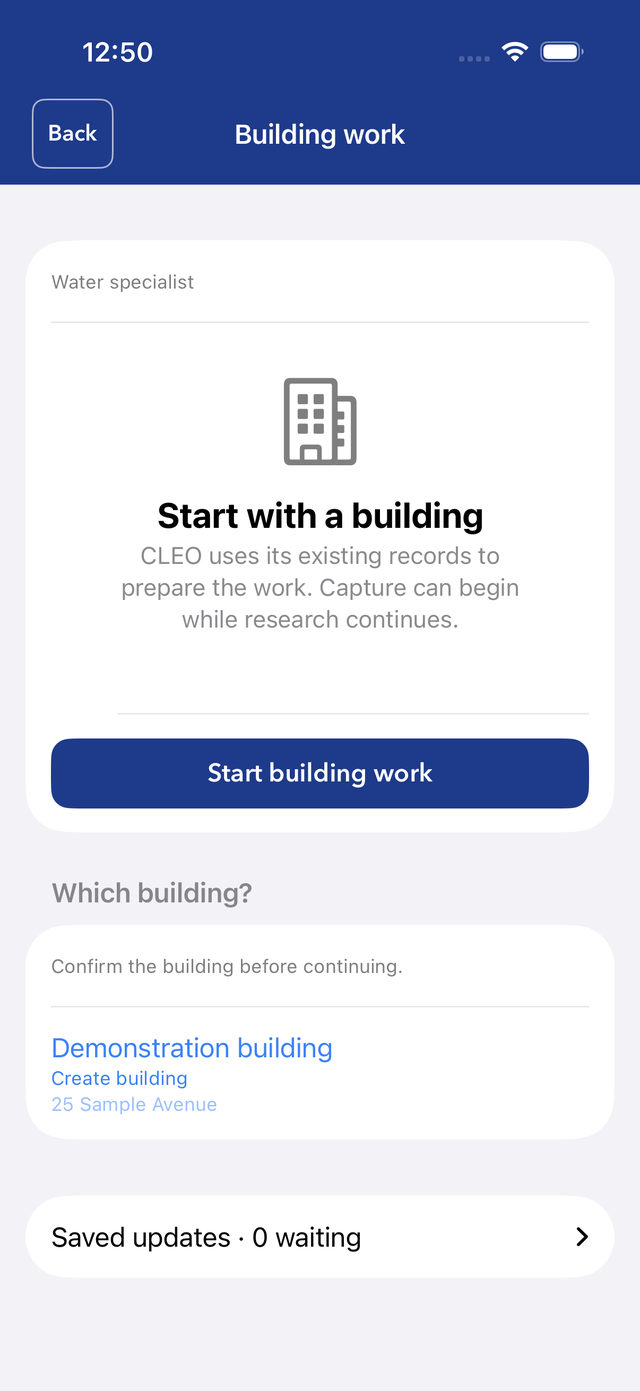
Water work starts from a building; field capture can begin while the research is still running. 02Ask what the record can’t answer
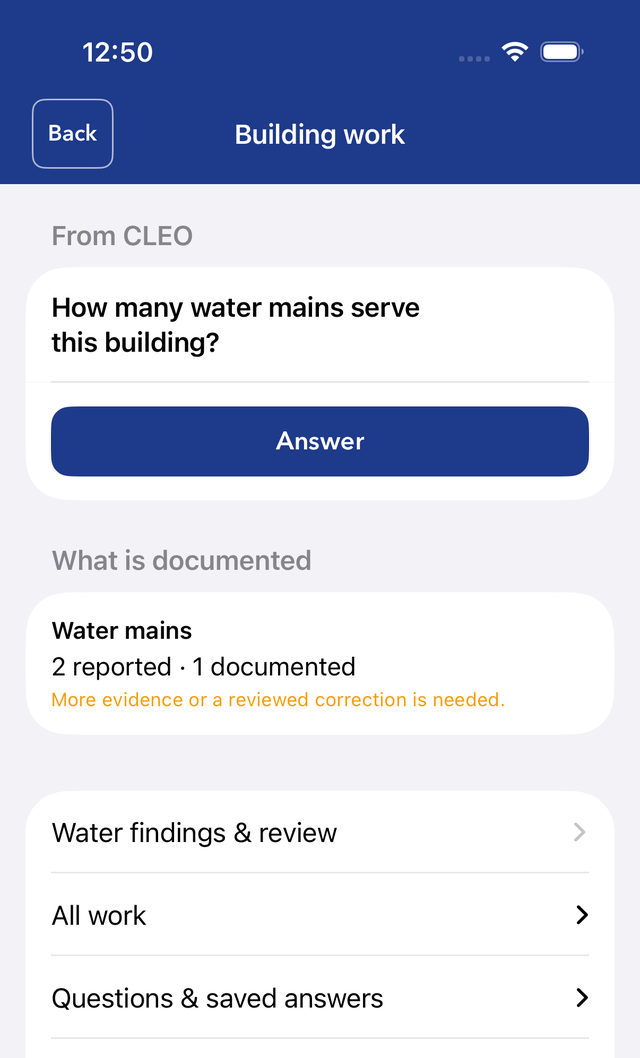
What was reported and what is documented are counted separately; the gap stays open until evidence or a reviewed correction closes it. 03Keep the gap open
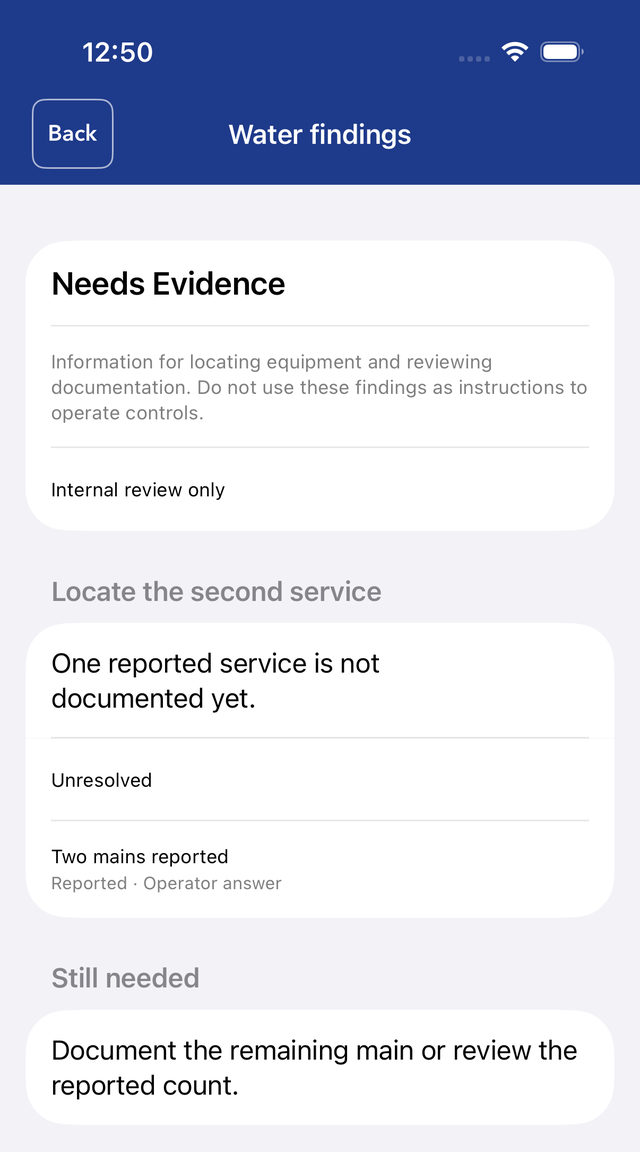
A finding stays 'Needs evidence' and unresolved until the second water service is documented.


Screens from the CriticalAsset app on a demonstration building. CLEO asks and advises; people answer and approve.
What you take to the underwriter
Day one: a cited record. Then the rest.
“Accurate location data, BI worksheets, business continuity planning, and robust CAT modeling and engineering data remain critical to securing optimal capacity and pricing outcomes.”
WTW, Insurance Marketplace Realities 2026: Property · 2025
From the address · day one
- A research brief across eight tracksEach finding with its source; uncovered tracks marked “not checked”.
- Commercial property dataBuilding characteristics, ownership, valuation, permits and construction history.
- Identity, structures and formProposed with sources, for your client to confirm in a click.
- A list of what is still openTracks with no coverage, questions only a person can answer, and the stages that need drawings or the walk.
What the client brings next
Drawings→PlansFloor plans and risers from the admin team, or on file with the building or fire department where available. One walk→Rooms & controlsOur field team walks the building with the CriticalAsset app; shutoffs are photographed and placed in 3D. Work orders→Pattern of lifeAn export or a connection, set up case by case, or the onboarding work orders we start.You bring the client. We bring the proof.
Send one address. We research the building, start its record and book the free Emergency Controls Report walk — then hand you evidence to take to market.